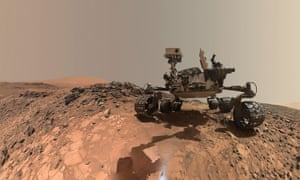
Nasa’s Curiosity rover at the site from which it reached down to drill into a rock target called Buckskin. Photograph: Nasa/Reuters
Ian Sample Science editor
Nasa scientists may still be celebrating their discovery of liquid water on Mars, but they now face some serious questions about how they can investigate further and look for signs of life on the red planet.
The problem is how to find life without contaminating the planet with bugs from Earth.
The Guardian view on the discovery of liquid water on Mars: cause for great celebration
Editorial: Now the search is on to find living organisms on the red planet. Even traces of primitive microbes would rank among the most important discoveries in history.
Researchers at the space agency are keen for the Curiosity rover to take a closer look at the long dark streaks created by liquid water running down craters and canyon walls during the summer months on Mars.
But the rover is not sterile and risks contaminating the wet areas with earthly bugs that will have hitched a ride to the planet and may still be alive.
The vehicle has been trundling around the large Gale crater looking for evidence that Mars was habitable in the ancient past. It has so far uncovered evidence of past river networks and age-old lakes.
However, the dark, damp streaks, called recurring slope lineae (RSL), are a different prospect. Because they are wet at least part of the time, they will be designated as special regions where only sterile landers can visit. But such a restriction could hamper scientists’ hopes of looking for current life on Mars.
“There will be heated discussions in the next weeks and months about what Curiosity will be allowed to do and whether it can go anywhere near the RSLs,” said Andrew Coates of University College London’s Mullard space science laboratory.
“Curiosity now has the chance, for example, to do some closer up, but still remote, measurements, using the ChemCam instrument with lasers, to look at composition. I understand there is increasing pressure from the science side to allow that, given this new discovery.”
Advertisement
An organisation called the committee on space research (Cospar) draws up the rules on what is called planetary protection, which exist to prevent missions from Earth contaminating the pristine environments of other worlds. Landers that are searching for life must be exceptionally clean, and fall under category IVb, but those entering special regions are category IVc missions and must be cleaner still.
Curiosity was designed for category IVb, and under Cospar rules is not allowed to enter areas where water might be flowing. But that might be up for discussion. Nasa’s Jim Green argues that the intense radiation environment on Mars, in particular the ultraviolet light, might have killed any bugs Curiosity carried into space, and so may be clean enough to move into the sites.
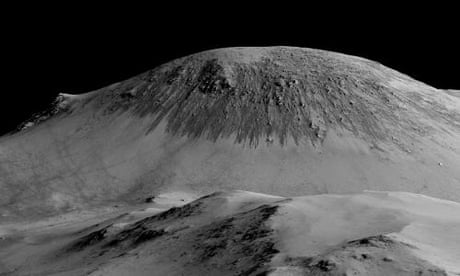
Nasa scientists find evidence of flowing water on Mars
A recent report from the US National Academy of Sciences and the European Science Foundation, however, suggests that UV light might not do the job, and could make matters worse. “Although the flux of ultraviolet radiation within the Martian atmosphere would be deleterious to most airborne microbes and spores, dust could attenuate this radiation and enhance microbial viability,” the report states.
Curiosity could inspect the flows from a distance, using its onboard laser to take more measurements of the dark streaks. But a more controversial option is to find a flat region at the bottom of one of the flows, and scoop up some Martian soil for analysis.
The next rover due to land on the planet is a joint mission named ExoMars from the European and Russian space agencies, set to launch in 2018. The plan is for the rover to drill up to two metres into the Martian soil to look for life past or present.
“For the ExoMars 2018 rover, the planetary protection is being very carefully looked at and a combination of baking and cleaning is planned to avoid any possible mishaps and make sure it is IVb so it can make the best possible life-searching measurements in the regions it can get to,” said Coates, who is leading the camera team on the rover.
Comments