Centre for Cities urges the government to address the geographical divide by continuing to increase investment in regional economies
 Industrial buildings in Doncaster, which is in the top 10 of low-wage, high-welfare cities. Photograph: Gabriel Szabo/Guzelian
Almost half of the UK’s biggest cities have low-wage, high-welfare economies, according to a healthcheck on urban Britain that underscores the challenges for the government’s benefit-cutting agenda.
George Osborne used his first budget of the Conservative government last summer to advocate a “higher wage, lower tax, lower welfare country”. But a report published on Monday warns that his vision will take several parliaments to create, given current shortfalls in education, a housing crisis and inefficient jobs programmes.
The Centre for Cities study also highlights a stark north-south divide between conurbations and urges the chancellor to deliver on promises to rebalance Britain’s economy with projects like the “northern powerhouse”.
The independent thinktank’s annual Cities Outlook, covering the UK’s 63 largest cities, classifies 29 as having low-wage, high-welfare economies. Nine of the worst performing city economies on the wages and welfare measure are in the north of England and Midlands, including Hull, Blackburn and Telford.
Low-wage, high-welfare cities
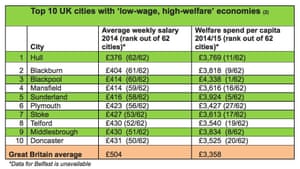
Facebook Twitter Pinterest The thinktank said the top 10 low-wage, high-welfare cities were ranked in order of lowest average wage, excluding places with lower than average welfare spend. Illustration: Centre for Cities
The report’s authors are urging the government to address the geographical divide by continuing to increase investment in regional economies, while giving cities more control over local tax revenue, skills, infrastructure and housing.
“One of the most pressing issues is the need to tackle skills gaps and improve schools’ attainment, especially in low-wage cities, to help those places attract businesses and jobs, and support more people to move into work, particularly in high-skill sectors,” said chief executive Alexandra Jones.
Britain’s wage and welfare picture
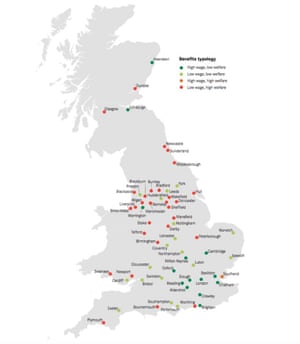
Facebook Twitter Pinterest A geographical look at Britain’s economical differences. Illustration: Centre for Cities
Jones called for an end to the duplication and other inefficiencies that result from the current system, where spending on employment and skills programmes is not connected to benefit spending.
“Cities also need more powers and incentives to boost jobs and wages. Giving places control over skills and welfare budgets, and allowing them to keep any savings made by reducing the welfare bill, would incentivise local leaders to invest in employment programmes that, if successful, would reduce people’s need for benefits payments.”
The report claims that 14 cities are already delivering “high-wage, low-welfare” economies. They include London, Aberdeen and Cambridge. Eight of the top 10 are in what the thinktank calls the “greater south east”.
High wage, low welfare
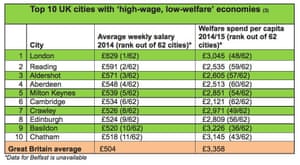
Facebook Twitter Pinterest The thinktank said the top 10 high-wage cities were ranked in order of highest average wage, excluding places with higher than average welfare spend. Illustration: Centre for Cities
The thinktank defines low-wage, high-welfare economies as places where average wages are below the national average, but welfare spending is above. High-wage, low-welfare cities are defined as those where average wages are higher than the national average, and welfare spending is lower.
Advertisement
The report also highlights challenges in high-wage cities, largely stemming from a lack of affordable housing. Welfare spending had grown at a much faster rate in high-wage cities, with benefit payments more than 50% higher than in other places – largely due to high demand for housing resulting in increased housing benefit payments.
“For cities which have seen strong growth in wages and jobs, the focus should be on addressing housing shortages, to ensure that their success isn’t derailed by a lack of affordable homes,” said Jones.
The thinktank warns each of the changes its recommends – improvements in education and skills levels, devolution and integration of budgets and services, and increases in housing supply – will take several years to deliver, and longer still for the full range of benefits to be felt.

The stories you need to read, in one handy email
“Creating a higher wage, lower welfare economy will, in all likelihood, be the work not of one parliament but of several,” it concludes.
Industrial buildings in Doncaster, which is in the top 10 of low-wage, high-welfare cities. Photograph: Gabriel Szabo/Guzelian Almost half of the UK’s biggest cities have low-wage, high-welfare economies, according to a healthcheck on urban Britain that underscores the challenges for the government’s benefit-cutting agenda.
George Osborne used his first budget of the Conservative government last summer to advocate a “higher wage, lower tax, lower welfare country”. But a report published on Monday warns that his vision will take several parliaments to create, given current shortfalls in education, a housing crisis and inefficient jobs programmes.
The Centre for Cities study also highlights a stark north-south divide between conurbations and urges the chancellor to deliver on promises to rebalance Britain’s economy with projects like the “northern powerhouse”.
The independent thinktank’s annual Cities Outlook, covering the UK’s 63 largest cities, classifies 29 as having low-wage, high-welfare economies. Nine of the worst performing city economies on the wages and welfare measure are in the north of England and Midlands, including Hull, Blackburn and Telford.
Low-wage, high-welfare cities
Facebook Twitter Pinterest The thinktank said the top 10 low-wage, high-welfare cities were ranked in order of lowest average wage, excluding places with lower than average welfare spend. Illustration: Centre for Cities


The report’s authors are urging the government to address the geographical divide by continuing to increase investment in regional economies, while giving cities more control over local tax revenue, skills, infrastructure and housing.
“One of the most pressing issues is the need to tackle skills gaps and improve schools’ attainment, especially in low-wage cities, to help those places attract businesses and jobs, and support more people to move into work, particularly in high-skill sectors,” said chief executive Alexandra Jones.
Britain’s wage and welfare picture
Facebook Twitter Pinterest A geographical look at Britain’s economical differences. Illustration: Centre for Cities


Jones called for an end to the duplication and other inefficiencies that result from the current system, where spending on employment and skills programmes is not connected to benefit spending.
“Cities also need more powers and incentives to boost jobs and wages. Giving places control over skills and welfare budgets, and allowing them to keep any savings made by reducing the welfare bill, would incentivise local leaders to invest in employment programmes that, if successful, would reduce people’s need for benefits payments.”
The report claims that 14 cities are already delivering “high-wage, low-welfare” economies. They include London, Aberdeen and Cambridge. Eight of the top 10 are in what the thinktank calls the “greater south east”.
High wage, low welfare
Facebook Twitter Pinterest The thinktank said the top 10 high-wage cities were ranked in order of highest average wage, excluding places with higher than average welfare spend. Illustration: Centre for Cities


The thinktank defines low-wage, high-welfare economies as places where average wages are below the national average, but welfare spending is above. High-wage, low-welfare cities are defined as those where average wages are higher than the national average, and welfare spending is lower.
Advertisement
The report also highlights challenges in high-wage cities, largely stemming from a lack of affordable housing. Welfare spending had grown at a much faster rate in high-wage cities, with benefit payments more than 50% higher than in other places – largely due to high demand for housing resulting in increased housing benefit payments.
“For cities which have seen strong growth in wages and jobs, the focus should be on addressing housing shortages, to ensure that their success isn’t derailed by a lack of affordable homes,” said Jones.
The thinktank warns each of the changes its recommends – improvements in education and skills levels, devolution and integration of budgets and services, and increases in housing supply – will take several years to deliver, and longer still for the full range of benefits to be felt.
The stories you need to read, in one handy email
“Creating a higher wage, lower welfare economy will, in all likelihood, be the work not of one parliament but of several,” it concludes.
The report also adds to evidence that the rapid rise in employment in recent years has not been accompanied by any tangible income growth. The Cities Outlook noted nearly a million new jobs were created in UK cities between 2010 and 2014 but that urban wages fell by 5% in the same period – a decrease in average annual salary of £1,300 per city dweller in real terms.
A spokeswoman for the Department for Communities and Local Government said: “Today’s report is out of date, ignores the latest Office for National Statistics figures showing the employment rate at a record-breaking 74%, and focuses solely on cities, which takes no account of employment growth in large swaths of the country.
“In fact, 1.5 million more people are in work outside London and the south-east compared with 2010, a third of new apprenticeship starts in the last year were in the northern powerhouse, and full-time wages grew faster in areas including Greater Manchester, Leeds, Birmingham and Worcestershire compared with the national average – even before our new national living wage takes effect in April this year.”
A spokeswoman for the Department for Communities and Local Government said: “Today’s report is out of date, ignores the latest Office for National Statistics figures showing the employment rate at a record-breaking 74%, and focuses solely on cities, which takes no account of employment growth in large swaths of the country.
“In fact, 1.5 million more people are in work outside London and the south-east compared with 2010, a third of new apprenticeship starts in the last year were in the northern powerhouse, and full-time wages grew faster in areas including Greater Manchester, Leeds, Birmingham and Worcestershire compared with the national average – even before our new national living wage takes effect in April this year.”
Comments