Exclusive Syrian Centre for Policy Research says 470,000 deaths is twice UN’s figure with ‘human development ruined’ after 45% of population is displaced
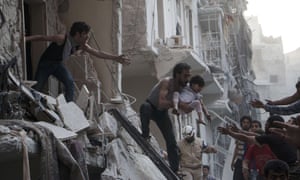 A man carries a child from a building following a reported barrel bomb attack by Syrian government forces on Aleppo. Some 50,000 people have fled the recent upsurge in fighting there. Photograph: Karam Al-Masri/AFP/Getty
Ian Black Middle East editor
Syria’s national wealth, infrastructure and institutions have been “almost obliterated” by the “catastrophic impact” of nearly five years of conflict, a new report has found. Fatalities caused by war, directly and indirectly, amount to 470,000, according to the Syrian Centre for Policy Research (SCPR) – a far higher total than the figure of 250,000 used by the United Nations until it stopped collecting statistics 18 months ago.
In all, 11.5% of the country’s population have been killed or injured since the crisis erupted in March 2011, the report estimates. The number of wounded is put at 1.9 million. Life expectancy has dropped from 70 in 2010 to 55.4 in 2015. Overall economic losses are estimated at $255bn (£175bn).
The stark account of the war’s toll came as warnings multiplied about Aleppo, Syria’s largest city, which is in danger of being cut off by a government advance aided by Russian airstrikes and Iranian militiamen. The Syrian opposition is demanding urgent action to relieve the suffering of tens of thousands of civilians.
The International Red Cross said on Wednesday that 50,000 people had fled the upsurge in fighting in the north, requiring urgent deliveries of food and water.
Talks in Munich on Thursday between the US secretary of state, John Kerry, and his Russian counterpart, Sergei Lavrov, will be closely watched for any sign of an end to the deadly impasse. UN-brokered peace talks in Geneva are scheduled to resume in two weeks but are unlikely to do so without a significant shift of policy.
Speaking in London on Wednesday, an opposition spokesman, Salim al-Muslet, said President Barack Obama could stop the Russian attacks. “If he is willing to save our children it is really the time now to say ‘no’ to these strikes in Syria,” he said. The Washington Post reported that Moscow had sent a letter to Washington proposing to stop bombing on 1 March.
Of the 470,000 war dead counted by the SCPR, about 400,000 were directly due to violence, while the remaining 70,000 fell victim to lack of adequate health services, medicine, especially for chronic diseases, lack of food, clean water, sanitation and proper housing, especially for those displaced within conflict zones.
“We use very rigorous research methods and we are sure of this figure,” Rabie Nasser, the report’s author, told the Guardian. “Indirect deaths will be greater in the future, though most NGOs [non-governmental organisations] and the UN ignore them.
“We think that the UN documentation and informal estimation underestimated the casualties due to lack of access to information during the crisis,” he said.
In statistical terms, Syria’s mortality rate increase from 4.4 per thousand in 2010 to 10.9 per thousand in 2015.
The UN high commissioner for human rights – which manages conflict death tolls – stopped counting Syria’s dead in mid-2014, citing lack of access and diminishing confidence in data sources.
The SCPR was based until recently in Damascus and research for this and previous reports was carried out on the ground across Syria. It is careful not to criticise the Syrian government or its allies – Iran, Hezbollah, Russia. And with the exception of Islamic State, it refers only to “armed groups” seeking to overthrow President Bashar al-Assad. But despite the neutral tone the findings are shocking.
In an atmosphere of “coercion, fear and fanaticism”, blackmail, theft and smuggling have supported the continuation of armed conflict so that the Syrian economy has become “a black hole” absorbing “domestic and external resources”.Oil production continues to be an “important financial resource” for Isis and other armed groups, it says.
Consumer prices rose 53% last year. But suffering is unevenly spread. “Prices in conflict zones and besieged areas are much higher than elsewhere in the country and this boosts profit margins for war traders who monopolise the markets of these regions,” it says. Employment conditions and pay have deteriorated and women work less because of security concerns. About 13.8 million Syrians have lost their source of livelihood.
“The common characteristics across all regions are lack of security, the allocation of all resources to the fighting, the creation of violence-related job opportunities and imposition of authority by force.”
The shrinking of the population by 21% helps explain the waves of refugees reaching Turkey and Europe. In all, 45% of the population have been displaced, 6.36 million internally and more than 4 million abroad. Health, education and income standards have all deteriorated sharply. Poverty increased by 85% in 2015 alone.
The report notes that the rest of the world has been slow to wake up to the dimensions of the crisis. “Despite the fact that Syrians have been suffering for … five years, global attention to human rights and dignity for them only intensified when the crisis had a direct impact on the societies of developed countries.”
The conflict “continues to destroy the social and economic fabric of the country with the intensification of international interventions that deepen polarisation among Syrians. Human development, rights and dignity have been comprehensively ruined.”
The report is entitled Confronting Fragmentation. Previous titles in the series track the unfolding of the world’s biggest humanitarian disaster: Syrian Catastrophe, War on Development, Squandering Humanity, and Alienation and Violence.
Comments