Leave campaign four points ahead in survey that shows just half of 18-34s are certain to cast their vote on 23 June
 An online survey by Opinium puts the Leave camp on 43%. Photograph: Stefan Rousseau/PA
Toby Helm Observer political editor
The decision over whether the UK remains inside the European Union could depend on whether young people shake off their apathy and vote in sufficient numbers on 23 June, a revealing opinion poll conducted for the Observer shows.
In a blow to David Cameron and the pro-EU camp, the online survey by Opinium puts the Leave side on 43%, four points ahead of Remain, on 39%. Some 18% of voters said they were undecided, while 1% refused to say.
Britain’s values were founded in Europe – how can we leave?
Andrew Graham
Read more
While most of the “don’t knows” said, when pushed, that they were leaning towards Remain, offering hope to the pro-EU side, the survey will serve as a wake-up call to leaders of all four main Westminster parties, who are urging people to back their calls for continued membership.
Above all, it will be deeply worrying for Cameron, who will almost certainly have to resign as prime minister in the event of a vote to leave. But it also adds to pressure on Labour leader Jeremy Corbyn. Only 47% of those asked said they identified him as being in favour of remaining in the EU, while 40% said they did not know his view and 12% believed he wanted to leave. Some 78% knew that Cameron wanted to remain in.
Government strategists and pollsters privately admit that the central problem for the Remain side is that its support for staying in the EU is strongest among young people, the group least likely to vote. Opinium found that in the 18-34 age group, 53% said they backed staying in, against 29% who wanted to leave. But only just over half (52%) in this age group said they were certain to actually go out and vote.
Among voters in the 55-and-over category, support for leaving was far stronger, as was their certainty to vote, offering a huge advantage to the Leave side.
Some 54% of voters aged 55 and over said they wanted to leave against 30% who wanted the UK to remain in the EU. But in stark contrast to younger voters, 81% of this group were certain to vote.
Adam Drummond of Opinium said the results showed the coalition of support for Remain looked far less solid than that for Leave: “This shows how important turnout levels are going to be, particularly given the disparity between how likely the young and the old are to vote. Young people are much more pro-EU but much less likely to bother voting, meaning that a key element of Remain’s coalition is looking flaky.”
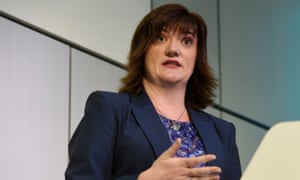
Education secretary Nicky Morgan says it would be young people who would suffer most if the UK left the EU. Photograph: Lauren Hurley/PA
The Remain camp is aware of the need to mobilise young people behind the campaign. Last week, in a sign of growing concern, education secretary Nicky Morgan made a speech saying it would be young people who would suffer most if the UK left the EU.
Her message was aimed not only at mobilising young people to vote but also at focusing parents and grandparents on the danger of Brexit to the next generation. “It’s clear that if Britain leaves Europe, it will be young people who suffer the most, left in limbo while we struggle to find and then negotiate an alternative model,” she said. “If parents and grandparents vote to leave, they’ll be voting to gamble with their children and grandchildren’s future.”
But the findings will add to concern that Britain could head out of the EU because the youngest voters fail to turn up. Today the Electoral Reform Society warns of a “worrying generation gap” as it publishes details of a survey showing that 21% of 18- to 24-year-olds say they are very interested in the EU referendum, compared with 47% of those over 65. Katie Ghose, its chief executive, said: “It seems like young people haven’t been engaged in a debate which has so far focused on personalities rather than the real issues which affect them. Not only do young people feel less interested, but they are, as we know, far less likely to vote.
“We know this is likely to be a once-in-a-lifetime vote for most people – the last referendum was in 1975 – so it’s all the more important that young people, who will be most affected by this decision in years to come, turn out. This will take effort – just 43% of 18- to 24-year-olds voted in last year’s general election – but it is vital.”
A spokesman for Britain Stronger in Europe said it was working “extremely hard” with young people and had established groups in more than 50 universities which were backing the cause. But he admitted that it was a challenge: “Young people have the most at stake in this referendum. It is their futures that are on the ballot paper. We will leave no stone unturned in our bid to get young people out to vote.”
Opinium Research carried out an online survey of 1,966 adults from 29 Mar-1 Apr
Comments