Human Rights Watch report calls on UK and other aid donors funding ambitious education programme to put pressure on government to halt abuses
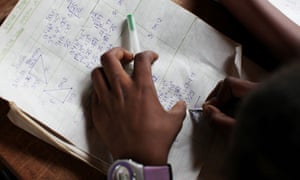 The report says female students are exposed to sexual harassment and that in some schools male teachers coerce them into sexual relationships. Photograph: Graeme Robertson for the Guardian
Sexual abuse, harassment and corporal punishment are widespread in schools in Tanzania, according to a report by Human Rights Watch (HRW) that called on donors funding one of Africa’s most ambitious education programmes to press for government intervention.
The report also found that more than 40% of adolescents in Tanzania were left out of quality lower-secondary education, despite a decision to make this schooling free. The country has one of the world’s largest youth populations, with 43% of people under the age of 15.
'I feel powerful and free. I want other girls in Zanzibar to feel that way'
Sita Hai Simai in Nungwi
The east African state, which has put young people at the heart of its aspiration to become a middle-income country by 2025, has been lauded for its December 2015 move to abolish all fees and charges for secondary schools. Enrolment has significantly increased as a result, according to the government.
But in its report, “I Had a Dream to Finish School”: Barriers to Secondary Education in Tanzania, the human rights group said that the country’s government needed to do more to address crowded classrooms, discrimination and abuse, which undermined many adolescents’ education.
It found that school officials conducted compulsory pregnancy tests and that, in most cases, girls were not allowed to re-enrol after their children were born.
The use of “brutal and humiliating forms” of corporal punishment was also found to be common in schools, affecting attendance. Although still lawful in the country, HRW said this violates Tanzania’s international obligations, and that the frequency with which it happened was “alarmingly high”.
Advertisement
The report said female students were exposed to widespread sexual harassment, and that in some schools male teachers attempted to persuade or coerce them into sexual relationships.
Although Tanzania was once regarded as one of Africa’s development success stories and one of the continent’s largest recipients of aid, international donors suspended nearly $500m (£400m) in budget support to the country in 2014 in response to claims that senior government officials siphoned off funds.
Nevertheless, major education programmes aiming to raise the quality of learning in its primary and secondary schools have received significant levels of external investment. Key donors include the World Bank (pdf) and the UK, which is investing more than £150m in education over an eight-year period (2013- 20).
Global Development - The Guardian African women form a united front in the battle for equality – podcast
Kary Stewart looks at how feminists are championing women’s rights across the continent and beyond
Listen
Elin Martínez, children’s rights researcher at Human Rights Watch, said the UK government was to be commended for its funding, but added: “Effective investment is about more than just pumping money into the system and getting children to physically attend school. It’s about making sure children are treated right once they get there too.
“Donors, including the UK, should push the Tanzanian government to make sure children are safe in schools, and it should urgently grapple with two of the biggest problems we’ve uncovered: corporal punishment and widespread sexual abuse.”
A spokeswoman for Britain’s Department for International Development (DfID) said the UK had helped more than a half a million students to receive a higher quality of education in Tanzania. “We are working with the government of Tanzania to implement lasting improvements to the education system, and have recently supported significant advances in literacy rates, pupil-to-teacher ratios and the number of pupils passing exams,” she added.
DfID support comes through two main initiatives – the Education Quality Improvement Programme and the Education Programme for Results, which was previously known as Big Results Now.
The former only provides support when key education results in primary and secondary education have been achieved, according to DfID, while the latter has worked with Tanzanian education authorities to develop a campaign to reduce corporal punishment and guide teachers on abiding by codes of conduct.
HRW interviewed more than 220 secondary school students, out-of-school adolescents, parents, education experts, local activists, development partners, and national and local government officials in eight districts in four regions of Tanzania.
https://www.theguardian.com/…/sexual-abuse-and-corporal-pun…
https://www.theguardian.com/…/sexual-abuse-and-corporal-pun…
Comments