Hundreds dead in India, Nepal and Bangladesh, while millions have been forced from their homes and 18,000 schools shut down across the region
Haroon Siddique and agencies
Heavy monsoon rains have brought Mumbai to a halt for a second day as the worst floods to strike south Asia in years continued to exact a deadly toll.
More than 1,200 people have died across India, Bangladesh and Nepal as a result of flooding, with 40 million affected by the devastation. At least six people, including two toddlers, were among the victims in and around India’s financial capital.
The devastating floods have also destroyed or damaged 18,000 schools, meaning that about 1.8 million children cannot go to classes, Save the Children warned on Thursday.
The charity said that hundreds of thousands of children could fall permanently out of the school system if education was not prioritised in relief efforts.
“We haven’t seen flooding on this scale in years and it’s putting the long-term education of an enormous number of children at great risk. From our experience, the importance of education is often under-valued in humanitarian crises and we simply cannot let this happen again. We cannot go backwards,” said Rafay Hussain, Save the Children’s general manager in Bihar state.
Advertisement
“We know that the longer children are out of school following a disaster like this the less likely it is that they’ll ever return. That’s why it’s so important that education is properly funded in this response, to get children back to the classroom as soon as it’s safe to do so and to safeguard their futures.”
On Wednesday, police said a 45-year-old woman and a one-year-old child, members of the same family, had died after their home in the north-eastern suburb of Vikhroli crumbled late on Tuesday, and a two-year-old girl had died in a wall collapse.
They said another three people had died after being swept away in the neighbouring city of Thane.
The rains have led to flooding in a broad arc stretching across the Himalayan foothills in Bangladesh, Nepal and India, causing landslides, damaging roads and electric towers and washing away tens of thousands of homes and vast swaths of farmland.
The International Federation of the Red Cross and Red Crescent Societies (IFRC) says the fourth significant floods this year have affected more than 7.4 million people in Bangladesh, damaging or destroying more than 697,000 houses.
They have killed 514 in India’s eastern state of Bihar, where 17.1 million have been affected, disaster management officials have been quoted as saying. In the northern state of Uttar Pradesh, about 2.5 million have been affected and the death toll stood at 109 on Tuesday, according to the Straits Times. The IFRC said landslides in Nepal had killed more than 100 people.
The IFRC – working with the Bangladesh Red Crescent Society and the Nepal Red Cross – has launched appeals to support almost 200,000 vulnerable people with immediate relief and long-term help with water and sanitation, health and shelter.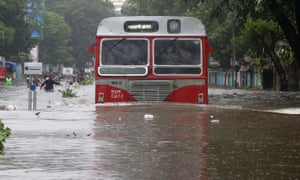
FacebookTwitterPinterest A passenger bus moves through a waterlogged road in Mumbai. Photograph: Shailesh Andrade


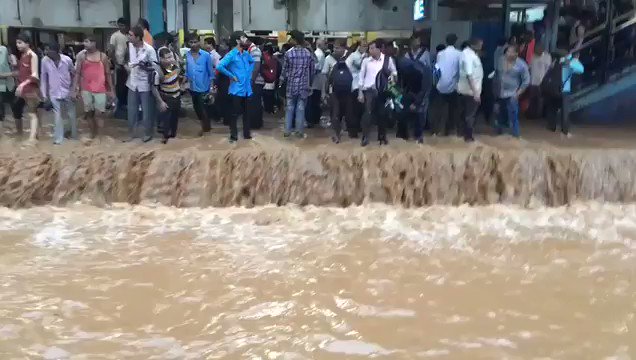
Streets in Mumbai have turned into rivers and people waded through waist-deep waters. On Tuesday, the city received about 12.7cm (5ins) of rain, paralysing public transport and leaving thousands of commuters stranded in their offices overnight.
Poor visibility and flooding also forced airport authorities to divert some flights while most were delayed by up to an hour.

The National Disaster Response Force has launched a rescue mission with police to evacuate people from low-lying areas but operations were thwarted by the continuous rain.
“The heavy rains, flooding, are delaying our rescue work. Even we are stranded,” said Amitesh Kumar, the joint police commissioner in Mumbai.
Images and video posted on social media showed the extent of the flooding.

Rainwater swamped the King Edward Memorial hospital in central Mumbai, forcing doctors to vacate the paediatric ward.
“We are worried about infections … the rain water is circulating rubbish that is now entering parts of the emergency ward,” said Ashutosh Desai, a doctor in the 1,800-bed hospital.
The rain water is circulating rubbish that is now entering parts of the emergency wardAshutosh Desai
Although Mumbai is trying to build itself into a global financial hub, parts of the city struggle to cope during annual monsoon rains.
Floods in 2005 killed more than 500 people in the city. The majority of deaths occurred in shanty town slums, home to more than half of Mumbai’s population.
The meteorological department warned that the rains would continue for the next 24 hours.
Unabated construction on flood plains and coastal areas, as well as storm-water drains and waterways clogged by plastic garbage, have made the city increasingly vulnerable to storms.
Snehal Tagade, a senior official in Mumbai’s disaster management unit, said 150 teams were being deployed to help the population in low-lying residential areas.
Low-lying parts of the city with a population of more than 20 million people experience flooding almost every year but large-scale flooding of this magnitude has not been seen in recent years.
“We are mapping all the flooding zones to launch a project to build emergency shelters to make evacuation easy,” said Tagade.
Many businesses asked employees to leave early in expectation of worsening traffic jams. Rains and a high tide in the western coastal city threaten to overload an ageing drainage system.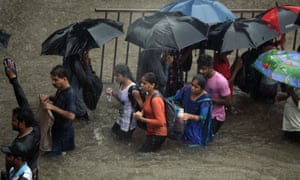
FacebookTwitterPinterest People walk along a flooded street in Mumbai. Photograph: Punit Paranjpe/AFP/Getty Images


Several companies have arranged for food and resting facilities for employees stuck in offices. Temples and other Ganesh pandals have been offering food and water to people stranded on streets.
People on social media have been offering help to strangers who have been stuck at various locations.
The education minister has asked all schools and colleges in the city to remain shut on Wednesday.
The flooding led to some power outages in parts of the city and the municipal corporation warned of more such cuts if water levels continued to rise.
A spokeswoman for Mumbai international airport said flights in and out of the airport, India’s second busiest, were delayed while some had had to be diverted.
Since you’re here …
… we have a small favour to ask. More people are reading the Guardian than ever but advertising revenues across the media are falling fast. And unlike many news organisations, we haven’t put up a paywall – we want to keep our journalism as open as we can. So you can see why we need to ask for your help. The Guardian’s independent, investigative journalism takes a lot of time, money and hard work to produce. But we do it because we believe our perspective matters – because it might well be your perspective, too.
I appreciate there not being a paywall: it is more democratic for the media to be available for all and not a commodity to be purchased by a few. I’m happy to make a contribution so others with less means still have access to information.Thomasine F-R.
If everyone who reads our reporting, who likes it, helps to support it, our future would be much more secure.
Comments