The Catalan parliament will meet over the coming days to agree its response to the Spanish government’s unprecedented decision to impose direct rule as speculation mounts that the regional president, Carles Puigdemont, is planning to press ahead with a unilateral declaration of independence.
On Saturday night, Puigdemont described Madrid’s move as the worst attack on Catalonia’s institutions since General Franco’s dictatorship and accused the Spanish government of “slamming the door” on his appeals for dialogue to resolve the country’s worst political crisis since its return to democracy 40 years ago.
Hours later, the Catalan government said it would fight “tooth and nail to defend Catalonia’s democratically elected institutions” and the mandate it had received through the unilateral independence referendum held on 1 October.
Its spokesman, Jordi Turull, told the Catalan radio station RAC1 that the coming week would be one “where decisions are taken … doing nothing doesn’t figure in our plans”.
He rejected demands for fresh elections to be held as a way to break the standoff, saying polls were “not on the table”.
Puigdemont signed a declaration of independence on 10 October, but proposed that its effects be suspended for two months to allow for dialogue.
Although Puigdemont has resisted internal political pressure to now formally declare Catalan independence, he has refused to rule out the move, which would escalate tensions further and could pit the regional police force, the Mossos d’Esquadra, against the thousands of Spanish Guardia Civil and national police officers deployed in Catalonia.
Even if he draws back from a declaration, many Catalans – including Mossos and civil servants – may decide to not to obey orders from Madrid, and tens of thousands of people could take to the streets to protect key regional government institutions.
The Spanish prime minister, Mariano Rajoy, said on Saturday that his government was taking the dramatic step of invoking article 155 of the constitution to “restore the rule of law, coexistence and the economic recovery and to ensure that elections could be held in normal circumstances”.
He said Puigdemont’s administration would be stripped of its powers and its functions would be assumed by the relevant ministries in Madrid. The government will submit its proposals to a vote in the Spanish senate on Friday.
The speaker of the Catalan parliament, Carme Forcadell, called the measures a “de facto coup d’etat” and Puigdemont said the legislature would meet to discuss it response.
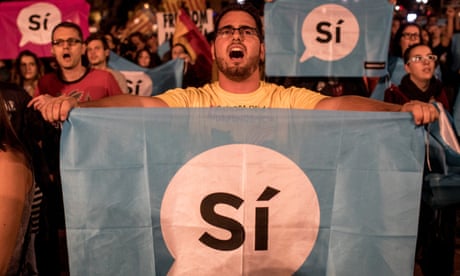
After the Catalan referendum: what happens next?
“I will ask parliament to call a plenary session in which the representatives of civil sovereignty – those who have been elected by the votes of citizens – can debate and decide how to respond to the attempt to eliminate our self-government and our democracy, and act accordingly,” he said in Saturday’s speech.
The board of the Catalan parliament is due to meet on Monday to fix a date for the plenary session.
Spain’s reaction had been firm and blunt. On Sunday, its foreign minister, Alfonso Dastis, said if a coup had taken place, it had been carried out by Puigdemont and his colleagues.
Dastis said the government was trying, “reluctantly”, to reinstate order in Catalonia following the referendum and called on people in the region to respect its decision.
“We are going to establish the authorities who are going to rule the day-to-day affairs of Catalonia according to the Catalan laws and norms,” he told the BBC’s Andrew Marr Show.
“I hope everyone will disregard whatever instructions [the current Catalan government] will be planning to give because they will not have the legal authority to do that.”
Dastis defended the Spanish police’s actions as they tried to halt the referendum, even though other members of the government have apologised for the violent scenes when officers raided polling stations, charged the crowds with batons and fired rubber bullets.
“I think by now many of those pictures have been proven to be fake pictures,” he said. “If there was any use of force, it was a limited one and prompted by the fact that the law and order agencies were prevented from discharging the orders of the courts.
“I’m not saying that all [of them] are fake pictures but some of them are and there have been a lot of alternative facts and fake news here. As I said, if there was at all – and according to the pictures there was – some use of force, it was not a deliberate use of force. It was a provoked use of force.”
Play Video
1:03 Spanish foreign minister defends police actions after Catalan referendum - video
Rajoy is the first Spanish prime minister to invoke article 155, the so-called “nuclear option” of Spain’s 1978 constitution. But Dastis insisted the government was merely enacting “a carbon copy” of an article that also exists in the German constitution.
Advertisement
“If you look at the rest of democracies and certainly partners in the European Union, they wouldn’t accept a decision as such to be taken by a part of the country,” he said.
Opposition politicians in Catalonia responded to Rajoy’s proposals by urging Puigdemont to drop his independence plans and calm the situation by calling elections.
Inés Arrimadas, the leader of the Catalan opposition, tweeted: “The irresponsible government has done away with the statute, closed parliament, broken coexistence and upset the economy. Re-establishing legality and calling elections would allow Catalonia to regain democracy and sense.”
The Catalan socialist party (PSC) told Puigdemont to call elections “so that Catalans can decide what course Catalan policy should take over the coming years” or to appear before the Spanish senate to offer a return to legality and pave the way for negotiations on Catalonia’s future.
Alex Ramos, the vice-president of Societat Civil Catalana, a group opposed to independence, said that while no one had wanted Madrid to step in, the blame lay with Puigdemont’s government and its headlong and undemocratic rush towards independence.
Comments