Theresa May’s decision to change passport colour as expression of ‘independence and sovereignty’ could mean travel delays
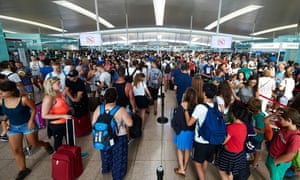 Travellers queue at the security checkpoints at Barcelona-El Prat airport, Spain. Photograph: Alejandro Garcia/EPA
 Dan Roberts and Jennifer Rankin in Brussels
European officials have warned that Britain’s new blue passports could spell travel delays and extra paperwork rather than the enhanced freedom promised by the government.
Theresa May sought to end a difficult political year on a high note on Friday by confirming the return of navy travel documents after Brexit. She said that abandoning the EU-style burgundy design introduced in 1988 was an expression of “independence and sovereignty” that reflected “citizenship of a proud, great nation”.
But as the announcement divided domestic opinion along increasingly entrenched cultural battle lines, sources in Brussels pointed out that holders of any colour of British passport could see diminished travel rights after Brexit unless there were further negotiating concessions.
One senior official said that “depending on how negotiations go on all free movement issues after Brexit” there was a significant risk that British passport holders would lose the right to use a fast-track citizens lane when travelling on the continent and may also be obliged to use a new visa waiver scheme.
The EU travel information and authorisation system (Etias) is modeled on the US Esta scheme and could require British travellers to Europe to register in advance and make a small administrative payment.
Although a chance remains for Britain to retain fast-track privileges if there is further shift in the prime minister’s red lines on immigration, British experts said this looked unlikely. “At the moment, it looks absolutely certain that we won’t be able to go through the European citizens lane because the legal code in the Schengen borders code says it is only for citizens or people with free movement rights,” said Steve Peers, a professor of law at Essex University.
Brussels sources pointed out that the tendering process for printing the new passports was likely to take place under existing EU procurement rules, something that the current British contractor, De La Rue, recently warned could mean they were produced abroad.
Despite this, the announcement was loudly cheered by Brexit supporters on Friday after a string of recent concessions from the government.
The Home Office minister Brandon Lewis told the Sun that “one of the most iconic things about being British is having a British passport”.
“You can’t be a nation unless you have this symbol,” added a jubilant Nigel Farage.
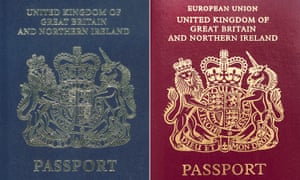 The old blue British passport and the burgundy European Union design introduced in 1988. Composite: PR
Under a system first agreed by Margaret Thatcher’s government in 1981, Britain is not legally obliged to use the same burgundy design as most other members but agreed to do so in a joint resolution of member states in the European council.
The agreement to harmonise certain design features followed a backlash over more ambitious plans for a community-wide passport, but it also included rules to put the words “European Community” in front of the name of the member state.
Council members, including Britain’s then ambassador to the EU, Michael Butler, signed a resolution aiming to “strengthen the feeling among nationals of the member states that they belong to the same community” but left an opt-out clause that is still used today by some members such as Croatia, which also has a blue passport.
May said Britain was choosing to return to its “iconic” blue design even though the shade proposed would be significantly lighter than the near-black navy used in previous, larger, UK passports. The majority of changes since this period have been mandated by other international aviation and security agreements outside the EU and will continue to dictate the size and content of UK travel documents.
Experts stressed that the balance between national sovereignty and harmonising travel rules was more complex than changing the appearance of a passport. “The reality is that the new passports will symbolise having fewer free movement rights,” said Peers. “We will also still have to go through the slow lane even if we have non-expired [burgundy] passports. It may not be vastly more difficult, but it will be somewhat more difficult.
“It does seem odd to make a big patriotic noise about something that makes it harder for you to travel.”
Fabian Zuleeg, chief executive of the European Policy Centre, agreed that it would depend on the final EU/UK settlement as to whether it would be harder for British passport holders to travel in Europe in future. If UK citizens were treated as nationals of the European Economic Area, the EU plus Norway, Iceland and Liechtenstein, then there would be no problem. “Otherwise they could face longer queues”, though he stressed nothing was definite.
In Britain, opposition politicians rejected the prime minister’s claim that changing the colour was a victory for sovereignty.
“What utter nonsense – this belittles our country and your office,” said the Labour MP Chuka Umunna. “We’ve always been a great nation, proud to be British and of our standing in the world.”
The former Labour leader Ed Miliband added: “It is an expression of how mendacious, absurd and parochial we look to the world.”
David Lammy, the MP for Tottenham, said Brexit was “turning us into a laughing stock”. “We’re swapping the right to live and work in 27 countries for new passports,” he said. “But don’t worry, when we’re all stood in the airport for four hours we can stand in the queue and look at just how blue they are.”
Academic experts on Brexit urged remain supporters not to underestimate the power of symbolism for leave supporters. “It’s a sign of the times that the mirror image of it appealing to a certain segment of the British population is that it will be a total turn-off to the other,” said Anand Menon at King’s College London. “It’s a reflection of how divided our society is: some people just cannot compute and other people are celebrating.”
The former British diplomat Sir Simon Wall suggested it was a measure carefully targeted at a demographic group most in need of buoying up after recent concessions.
“It’s aimed at the Brexit generation. Anyone under the age of 50 will hardly remember any other passport than we have now,” he said. “It seems from her recent performance that Theresa May has belatedly grasped the fact that we need to make some pretty dramatic compromises and she needs a bit of smoke as well – this is part of that.”
European officials distanced themselves from the original decision to adopt burgundy passports, stressing it was voluntarily agreed to by member state governments. “This has nothing to do with the European commission, nothing at all,” said the spokesman Mark English.
Claude Moraes, the British Labour MEP, who chairs the European parliament’s civil liberties, justice and home affairs committee, warned that the new passports could become a symbol of what British nationals stand to lose from Brexit.
“What is being lost with the burgundy passport are the freedoms to move in the EU27 and other related freedoms,” he said. “There is every risk now that with the UK passport you will be subject to greater queus, greater checks and more inconvenience.”
The MEP, who is one of the lead negotiators for the parliament on Etias, said he was “deeply sceptical” that the EU27 would offer the UK a special deal. He said the UK would be on the other side of policies aimed at strengthening the EU’s external border, including Etias and a stronger border and coastguard agency.
“That is something people will have to get used to and the new passport will symbolise that.”
Since you’re here …
… we have a small favour to ask. More people are reading the Guardian than ever but advertising revenues across the media are falling fast. And unlike many news organisations, we haven’t put up a paywall – we want to keep our journalism as open as we can. So you can see why we need to ask for your help. The Guardian’s independent, investigative journalism takes a lot of time, money and hard work to produce. But we do it because we believe our perspective matters – because it might well be your perspective, too.
High-quality journalism is essential intellectual nourishment. The generosity of providing such a service without a paywall deserves recognition and support. Giacomo P, Italy
If everyone who reads our reporting, who likes it, helps fund it, our future would be much more secure. For as little as £1, you can support the Guardian – and it only takes a minute. Thank you.
Comments