


 |
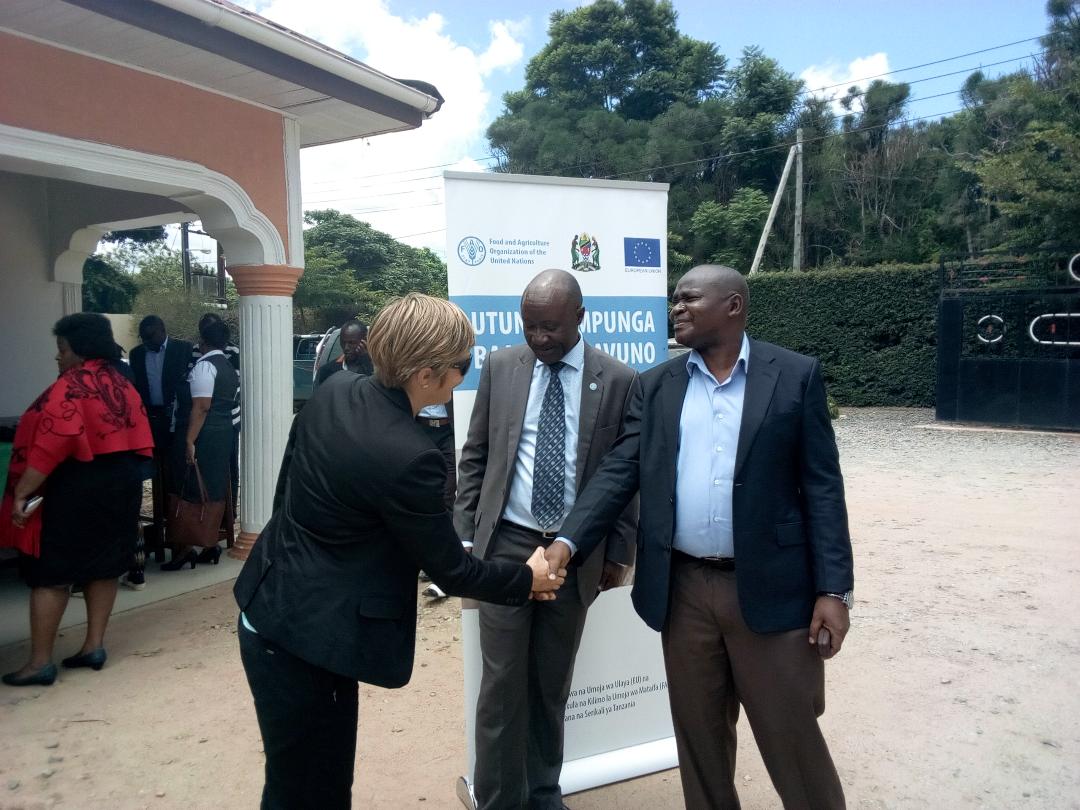
| (L-R)The Agriculture Project Manager of the Delegation of the European Union to Tanzania, Liesl Karen Inglis (L), FAO representative to Tanzania Fred Kafeero and Iringa DC District Executive Director Robert Masunya pose for the photo after the launching ceremony of EU funded project ' improve competitiveness and increase post harvest management capacity of smallholder farmers in the rice value chain held in IRINGA yesterday. (Photo by Friday Simbaya) |
 |
IRINGA: Over 10,000 rice farmers in Iringa region including women, youth, and men are going to benefit from a project that aims to equip them with post-harvest management skills to enhance their competitiveness in the market.
Dubbed ‘Improve Competitiveness and Increase Postharvest Management Capacity of Smallholder Farmers in the Rice Value Chain’, the project was launched and presided over by the Iringa Regional Commissioner, Amina Masenza.
The project is jointly funded by the European Union (EU) and the Food and Agriculture Organization of the United Nations (FAO) to the tune of 1,875,000 Euros (over 5.2 billion Tanzanian Shillings) the project is going to be implemented in Iringa District, Iringa region by FAO in collaboration with the Ministry of Agriculture and the Rural Urban Development Initiatives (RUDI).
The EU is supporting this project with a contribution of 1.5 million Euros. (Approx. 3.9 billion Tanzanian Shillings).
Speaking at the launch, Masenza said that the project will add into the ongoing efforts by the Government and other partners in the region to reduce postharvest losses which account for about forty percent of all the harvests.
“The Government takes the issue of food security as a priority. We are working with partners from both public and private sectors to improve food production in the country,” she said adding: “The main objective is to ensure that there is enough investment in the value chain from production, storage, processing, packaging, transporting and accessing markets to avoid post-harvest losses that could lead into food insecurity.”
Masenza said that the project will educate the farmers and agricultural inputs suppliers on how to control postharvest losses through appropriate and affordable storage.
“Definitely the project we are launching here today is a big step towards supporting Government’s efforts in addressing postharvest losses,” she pointed out.
The Agriculture Project Manager of the Delegation of the European Union to Tanzania, Liesl Karen Inglis said during the launch that: “despite the numerous challenges faced by the sector, great opportunities also exist.
The sustained increase in demand for aromatic rice guarantees a growing domestic and regional market for rice producers and the availability of improved technology provides farmers with clear pathways to increase outputs and profits.”
On his part, the FAO Representative to Tanzania, Fred Kafeero, said that proper post-harvest management was necessary to ensure food security. “Farmers are at the core of the value chain as they play a significant role on the source of the produced goods,” Kafeero said.
"With improved competitiveness and post-harvest losses management, paddy and other cereals can definitely make the country food self-sufficient, resulting in poverty reduction, increased incomes while ensuring a sustainable supply of food and reliable market for farmers," he added.
In contribution to the SAGCOT initiative, the project will build the managerial capacities of farmer’s organizations to put them at leverage position in collaboration with other value chain actors hence increasing their competitiveness, reducing post-harvest losses, maintaining quality and quantity.
This project implemented by FAO is one of three projects that the EU is financing under the 10th European Development Fund. The three projects with FAO, AGA KHAN and HELVETAS amount to a total of 4.5 Million Euros under the (SAGCOT) initiative. These are the agriculture last projects funded under the 10th EDF because the 10th EDF funding cycle has ended.
The European Union will continue to support the Agriculture Sector as one of its priority areas in Tanzania under the 11th EDF that runs from 2014-2020 for a total of 140 Million Euro.
Agriculture is a key driver of growth in Tanzania and also offers an opportunity for strengthening commercial linkages with the European Union.
The European Union under the 10th and 11th EDF has invested more than 74 million Euro in SAGCOT.
The areas of investment have been in roads, energy, environment and agriculture, with the aim of supporting the SAGCOT Initiative to boost agricultural output through public and private investment.
Comments